Table of Contents
What Actually Happens Once You Reach Out
Our Custom Software Development Services Process
Engagement Models: Which One Fits Your Project
What Custom Software Development Services Actually Cost
Who Owns the Code When It’s Done
What Sets Alphonic’s Process Apart
FAQs
If you already know what a custom software development company does and you’re now evaluating whether Alphonic specifically is the right fit, this is the post for that. It covers our custom software development services process end to end: how a project actually starts, what the engagement models mean in practice, and real pricing ranges instead of “contact us for a quote.” If you’re still figuring out whether custom development is the right call for your business in the first place, our guide to what a custom software development company does covers that groundwork first.
For more info: WhatsApp us at +91 9887133338
What Actually Happens Once You Reach Out
A discovery call, not a sales pitch. Before anything gets scoped or quoted, we spend time understanding the actual problem: what’s broken, what’s missing, and what the business is trying to achieve, not just what feature list someone walked in with. A good discovery conversation often changes the shape of the original request, and that’s the point.
From there, you get a real scope: what an MVP would include, what a fuller build looks like, and a timeline and cost range for each, before any contract gets signed.
Our Custom Software Development Services Process
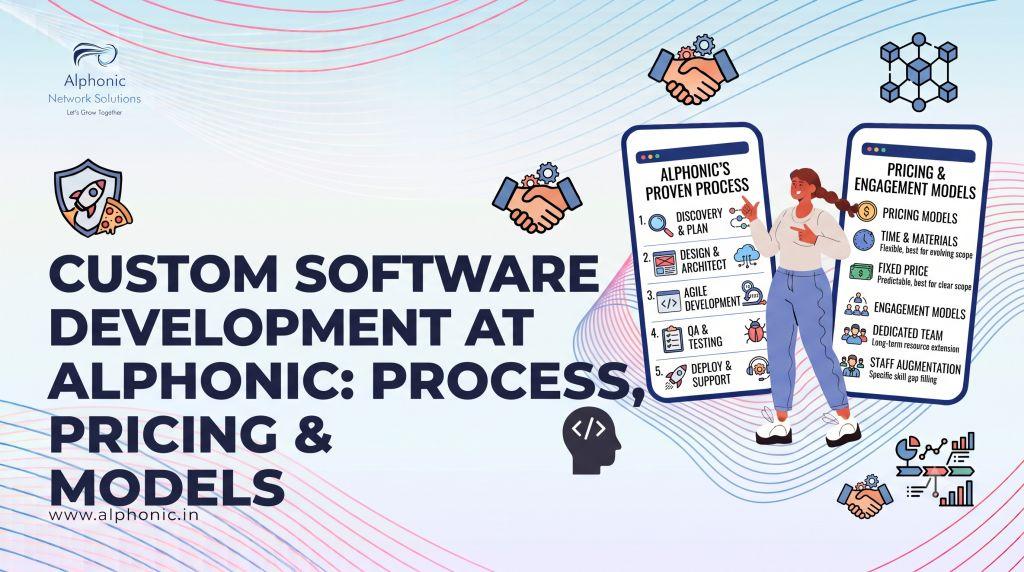
- Discovery and requirements. Understanding the business problem, not just the feature request, and identifying what actually needs to be built first versus what can wait.
- Technical architecture and stack selection. Choosing the technology based on the project’s real scale and integration needs, not defaulting to whatever’s trendy that quarter.
- UI/UX design. Wireframes and design work happen before development starts, so the team isn’t building against a moving target.
- MVP development. The smallest version that’s genuinely usable, built first, so there’s something real to test and react to before the full build is committed to.
- Quality assurance. Testing runs throughout the build, not just as a final check before launch.
- Deployment. Getting the product live, configured correctly, and integrated with whatever systems it needs to talk to.
- Ongoing support. Software needs maintenance after launch, security patches, updates, and feature additions as the business evolves. This isn’t an afterthought tacked onto the contract; it’s planned for from the start.
Engagement Models: Which One Fits Your Project
Fixed price. Works when the scope is genuinely well-defined and unlikely to shift. You know the total cost upfront. The tradeoff: any real change in requirements becomes a renegotiation, so this model only works well when the project is actually fixed, not just labeled that way.
Time and materials. Billed for actual hours worked. This fits projects with real uncertainty, which is most custom software projects, since it lets scope adjust as you learn more without renegotiating a contract every time. It requires trust and clear reporting on where the hours are going.
Dedicated team. A team assigned specifically to your project on an ongoing basis, billed monthly. This works best for products that need continuous development after launch, not just a one-time build, since it gives you continuity without repeating onboarding every time something new needs building.
None of these is universally correct. The right one depends on how well-defined your requirements actually are and whether the relationship is a single build or an ongoing product partnership.
What Custom Software Development Services Actually Cost
Most of our projects run in the $5,000 to $75,000 range. A lean MVP sits at the lower end of that. A full platform with backend logic, third-party integrations, and an admin dashboard costs more, and the exact number depends on scope, not a flat rate.
On timeline: an MVP typically takes 8 to 12 weeks. A full build runs 4 to 6 months, longer when there are several third-party integrations to work through. These are realistic ranges, not best-case marketing numbers, and a real quote always follows an actual scoping conversation rather than a number pulled from a price list.
Who Owns the Code When It’s Done
All the code and intellectual property built for you belongs to you, in full, once the project is complete. We also sign an NDA as standard practice on client engagements, since the details of what you’re building are yours to protect, not ours to reference elsewhere.
What Sets Alphonic’s Process Apart
Twelve-plus years building custom software across 500+ clients and 700+ projects gives us a working sense of what actually breaks projects: vague requirements that get more expensive to fix the later they’re caught, and pricing models that don’t match the actual uncertainty in the work. Our process is built to catch both early rather than discover them mid-build.
If you’re ready to talk specifics, our custom software development services page is the direct starting point, or reach out for a scoping conversation before committing to anything.
For more info: WhatsApp us at +91 9887133338
FAQs
How much do custom software development services cost at Alphonic?
Most projects fall between $5,000 and $75,000, depending on scope. A lean MVP sits at the lower end; a full platform with integrations and an admin dashboard costs more. A specific number comes from a scoping conversation, not a flat rate.
How long does a custom software project take from start to finish?
An MVP typically takes 8 to 12 weeks. A full build runs 4 to 6 months, and longer if the project involves several third-party integrations.
What’s the difference between fixed price, time and materials, and dedicated team pricing?
Fixed price suits well-defined, unlikely-to-change scope. Time and materials fits projects with real uncertainty, which covers most custom builds. Dedicated team works best for ongoing product development rather than a single one-time build.
Do I own the code once the project is finished?
Yes. All code and intellectual property built for your project belongs to you in full once delivered.
Do you sign an NDA before starting a project?
Yes, this is standard practice on our engagements, since the specifics of what you’re building should stay protected.
What happens in the first conversation before a project starts?
A discovery call focused on the actual business problem, not just a feature list, followed by a real scope with cost and timeline ranges before anything gets signed.
Does support end once the software is launched?
No. Ongoing maintenance, security updates, and feature additions are part of the process, planned for from the start rather than added as an afterthought once the initial build is live.