Table of Contents
The Problem: Three Titles, One Job Description
What Each Title Actually Means If You’re Trying to Hire AI Engineer 2026
Why “Prompt Engineer” Is a Warning Sign, Not a Job Title
Real Salary and Market Data
How to Write a Job Description That Attracts the Right Candidate
Do You Actually Need an AI Engineer, or Something Else?
Where Alphonic Fits
FAQs
Post a job for “AI Engineer” right now and you’ll get applicants who’ve spent three years training computer vision models, applicants who’ve spent six months building chatbot integrations, and applicants who genuinely aren’t sure which category they fall into either. This isn’t a hiring-market quirk, it’s a real, measurable problem: 72% of employers say they can’t find the AI talent they actually need, and a meaningful chunk of that gap comes from companies writing job descriptions for a title that doesn’t mean what they think it means.
For more info: Email us at [email protected]
The Problem: Three Titles, One Job Description
“AI Engineer,” “Machine Learning Engineer,” and “Prompt Engineer” get used almost interchangeably in job postings, but the actual day-to-day work behind each one is meaningfully different. Hiring the wrong one means paying for expertise you don’t need while still missing the expertise you actually do.
AI skill requirements now show up in 71% of U.S. tech job postings, up 181% year over year, which tells you how fast this space is growing. It doesn’t tell you what any specific posting actually needs, and that gap is where most mis-hires happen.
What Each Title Actually Means If You’re Trying to Hire AI Engineer 2026
Machine Learning Engineer works closest to the data and the model itself: selecting and training models, evaluating and tuning performance, deploying into production, and monitoring for drift over time. Strong mathematical and statistical foundation required, deep learning architectures, frameworks like PyTorch or TensorFlow. Hire an ML Engineer when you need a custom model built from your own data, not an off-the-shelf AI service integrated into a product.
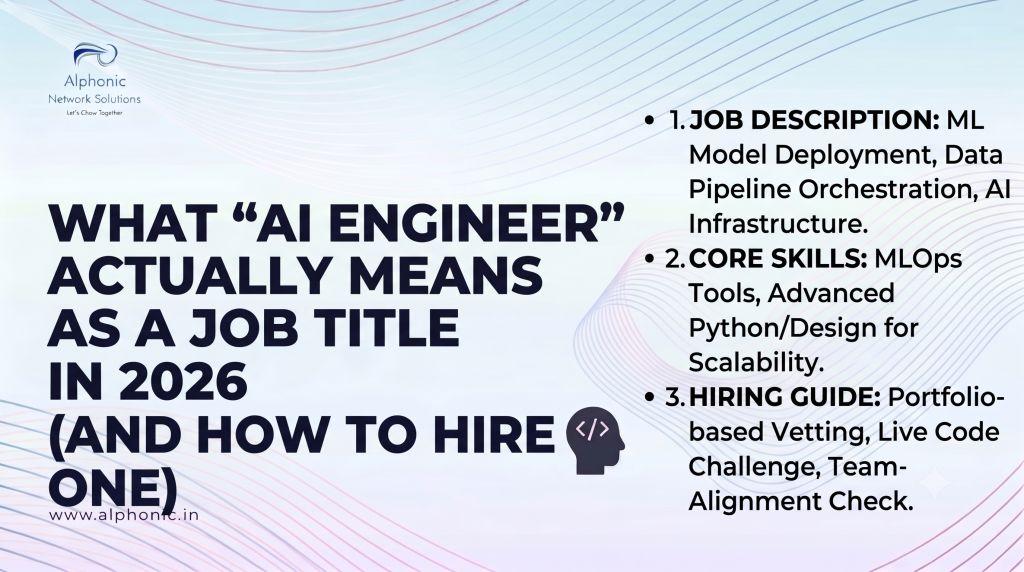
AI Engineer ships AI-powered features in production without necessarily training models from scratch: retrieval pipelines, vector stores, prompt and tool-use logic, foundation-model integration, agent design. Strong software engineering fundamentals, APIs, cloud infrastructure, deployment pipelines, matter more here than deep ML theory. Hire an AI Engineer when you’re integrating existing models (via API or fine-tuning) into a real product, not training new ones.
Prompt Engineer as a standalone full-time title is fading fast, not because the skill stopped mattering, but because it’s been absorbed into broader roles. What’s left of the job (designing and testing prompts, building evaluation systems, debugging agent behavior) now lives inside AI Engineer or AI Product roles rather than getting hired for separately.
Why “Prompt Engineer” Is a Warning Sign, Not a Job Title
Here’s a useful signal for 2026 specifically: standalone “Prompt Engineer” job postings have declined roughly 30% since 2024, while LinkedIn postings tagging prompt engineering as a skill have grown roughly 250% over the same window. The work didn’t disappear, prompt design, eval systems, agent debugging are all still very real and increasingly technical. What disappeared is the idea that it’s a standalone job for someone with no other technical background.
If you’re actively writing a job posting titled “Prompt Engineer” in 2026, that’s usually a sign the actual gap on your team is a generalist AI Engineer role, or a specific piece of work (eval systems, schema design) that nobody currently owns, not a role that title accurately describes anymore.
Real Salary and Market Data
As of May 2026 job board data, Machine Learning Engineer postings (4,781) slightly outnumber AI Engineer postings (4,091) in the US market, and ML Engineer commands a higher median base salary, $165,000 versus $145,000 for AI Engineer, a roughly 14% gap. Neither title is particularly entry-friendly: only about 5.8% of AI Engineer postings and 4.8% of ML Engineer postings are explicitly entry-level.
Worth internalizing from this data: title-based hiring is an unstable signal on its own. The work attached to a given title varies enough between companies that ownership should be assigned by actual output and responsibility, not by matching a candidate’s resume title to your job posting title. That’s the core lesson behind every recommendation in this guide to hire AI engineer 2026 talent effectively.
How to Write a Job Description That Attracts the Right Candidate
- Name the actual deliverable, not the buzzword. “Build and maintain a production RAG pipeline for our support product” attracts a fundamentally different, and more accurately matched, candidate pool than a generic posting to hire AI engineer 2026 with no scope attached.
- State clearly whether model training is in scope. If the role never touches training a model from scratch, say so explicitly, this alone filters out a large share of ML Engineer applicants who aren’t the right fit and saves everyone’s time.
- List the actual infrastructure the role touches. Vector databases, specific cloud providers, existing API integrations, whatever’s real, not a generic “familiarity with AI/ML” line that could mean almost anything.
- Avoid “Prompt Engineer” as a standalone title unless the role is actually narrow enough to justify it, which is now rare. If prompt and eval work is part of a broader AI Engineer role, title it that way.
- Be upfront about seniority expectations. Given how few entry-level postings exist in this space, vague seniority language wastes both your time and a junior candidate’s.
Do You Actually Need to Hire AI Engineer 2026 Talent, or Something Else?
Worth asking honestly before writing the job posting at all: if the actual need is reliable infrastructure and deployment for AI features already designed, that’s closer to a platform or DevOps role with AI-adjacent experience, not a dedicated AI Engineer. If the need is a single, well-scoped AI feature (a chatbot, a recommendation engine) rather than an ongoing AI product function, a project-based engagement with a development partner often makes more sense than a full-time hire, at least until the workload justifies a permanent role.
Our post on agentic AI logistics app development is a concrete example of the kind of production AI-feature work an AI Engineer role typically covers, worth a read if you’re still scoping what the role actually needs to own.
Where Alphonic Fits
We already have this title confusion sorted out internally, so when you work with us, you’re not gambling on whether the person assigned to your AI feature actually has the skills the title implies. Whether you’re trying to hire AI engineer 2026 talent directly or want a partner who already employs the right specialization, our hire developers page breaks down engagement options by actual specialization rather than a generic title. If you’re still weighing whether to hire in-house at all versus bringing in a development partner, our guide on how to hire a software development company covers that broader decision.
For more info: Email us at [email protected]
FAQs
What does “AI Engineer” actually mean as a job title in 2026?
Someone who ships AI-powered features into production, retrieval pipelines, vector stores, prompt and tool-use logic, foundation-model integration, typically without training models from scratch. That’s distinct from a Machine Learning Engineer, who builds and trains custom models.
What’s the difference between an AI Engineer and a Machine Learning Engineer?
An ML Engineer works closest to the model itself: training, tuning, and deploying custom models, with a strong mathematical and statistical foundation. An AI Engineer integrates existing models and AI services into real products, leaning more on software engineering and infrastructure skills than deep ML theory.
Is “Prompt Engineer” still a real job title to hire for in 2026?
Rarely as a standalone full-time role. The skill (prompt design, evaluation systems, agent debugging) is real and in high demand, but it’s increasingly folded into broader AI Engineer or AI Product roles rather than hired for separately.
How much should I expect to pay to hire an AI Engineer in 2026?
Recent US job board data shows a median base salary around $145,000 for AI Engineer roles, compared to roughly $165,000 for Machine Learning Engineer. Actual compensation varies significantly by seniority, location, and company stage.
Why is it so hard to find the right AI talent right now?
Part of it is genuine scarcity, 72% of employers report difficulty finding the AI talent they need, but a meaningful share of that gap comes from job descriptions written around an unclear or mismatched title, attracting candidates whose actual skills don’t match what the role needs.
Do I actually need a dedicated AI Engineer, or could I outsource this work instead?
Depends on scope. A single, well-defined AI feature is often more efficient as a project-based engagement with a development partner than a full-time hire, at least until the ongoing workload clearly justifies a permanent role.
What should I check before writing an AI Engineer job description?
Whether model training is actually in scope (if not, say so explicitly), what specific infrastructure and tools the role touches, and whether the work is broad enough to justify an “AI Engineer” title versus a narrower, more accurately named role.