Table of Contents
Fractional vs Full-Time Developers: The Short Answer
What the Market Is Doing in 2026
What Fractional vs Full-Time Developers Actually Cost
The 4-Question Ownership Test
Role by Role: Who to Keep Full-Time Where
Flexible Hiring Breaks A Practical Rollout Where Alphonic Fits
Fractional vs Full-Time Developers: FAQs
A founder posts a senior backend role, waits three months, and finally hires someone at $200K. Six weeks later the team realizes half the work was a one-time payments integration and a security review. The hire is great. The role was wrong.
That’s the usual story behind the fractional vs full-time developers debate. Most teams default to full-time because it feels safe, then discover they bought permanent capacity for temporary problems. This guide gives you a way to settle fractional vs full-time developers decisions role by role, with the math to back it up.
For more info: Email us at : [email protected]
Fractional vs Full-Time Developers: The Short Answer
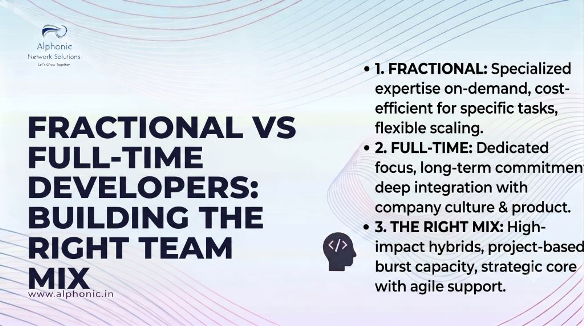
Hire full-time developers for work that changes weekly and needs someone who holds the context. Use a fractional developer when you need senior judgment a few days a week, like architecture, DevOps or security review. Use a project contractor for finite work you can describe in writing, and a dedicated partner team when you need capacity fast.
| Model | Choose it if | Watch out for |
|---|---|---|
| Full-time engineer | The work is core, changes often, and context is hard to transfer | Slow hiring, high fixed cost |
| Fractional developer | You need senior judgment for under about 25 hours a week | Divided attention, limited availability |
| Project contractor or gig worker | Scope is finite and written down | Context walks out the door at handover |
| Dedicated partner team | You need a working team in weeks, not quarters | Needs a clear owner on your side |
What the Market Is Doing in 2026
Companies aren’t picking one model. Robert Half’s mid-2026 survey of US hiring managers found that 78% of tech leaders plan to add permanent headcount while 66% expect to add contract professionals in the second half of the year. That’s a blend, not a switch.
Part of the reason is that hiring is hard. Robert Half also reports that only 7% of tech hiring managers feel confident they can fill in-demand roles. When a full-time search takes a quarter, flexible capacity stops being a luxury. That’s why fractional vs full-time developers is now a team-design question, not a one-off hiring choice.
Two caveats. Most of this data is US-based, so treat the percentages as direction, not as a benchmark for Jaipur, Dubai or London. And some of the loudest numbers about fractional work, like the 149% year-on-year demand growth in the Fractional Work Report 2026, come from a marketplace that sells fractional talent and mostly cover executives, not hands-on developers.
What Fractional vs Full-Time Developers Actually Cost
Start with the full-time number most people forget. Salary isn’t the cost. Benefits, tools, recruiting and management time typically push the fully loaded figure to roughly 1.25 to 1.4 times base, so a senior US engineer easily clears $200K all-in.
Now the flexible side of fractional vs full-time developers. Arc.dev’s survey of more than 5,000 freelancers puts senior rates around $100 to $180 an hour. Take $140 as a midpoint:
- 10 hours a week comes to about $72,800 a year
- 40 hours a week comes to about $291,200 a year
- the break-even against a $200K loaded hire lands near 27 hours a week
That break-even is the useful part. Below roughly 25 hours a week of steady need, fractional usually wins on cost. Above it, you’re paying a premium for flexibility you may not be using. Those are US-market figures from a marketplace, so rerun the math with your own rates before you commit. If you’re weighing an offshore or partner team instead, our breakdown of the ROI of outsourced software development shows how to measure it properly.
The 4-Question Ownership Test
Cost is only half of the fractional vs full-time developers decision. Run each role through these four questions.
1. How often does the work change? If priorities shift every sprint, you want someone embedded who absorbs those shifts without a briefing. If the work holds still for weeks, it can be handed to someone who isn’t in the room every day.
2. What happens if this person leaves? Context risk is the real price of flexible hiring. If losing them means losing a year of understanding about your payment logic, that role needs full-time ownership.
3. Can you write the work down? A migration with clear acceptance criteria suits a contractor. “Make the product feel faster” doesn’t.
4. Are you buying hours or judgment? Hours are cheap to rent. Judgment is what a fractional senior sells, and you only need a slice of it.
Score each role. Mostly “changes often” and “high context risk” points to full-time. Mostly “specifiable” and “hours” points to a contractor or gig worker. Judgment without constant presence points to fractional.
Role by Role: Who to Keep Full-Time
Here’s how fractional vs full-time developers usually splits by role.
Core product engineers should almost always be full-time. They carry the context, they review each other’s work, and nobody else will care about the codebase in year three.
The tech lead or CTO function is the classic fractional hire. An early-stage team rarely needs 40 hours a week of architecture decisions. A fractional CTO at roughly $5K to $25K a month, depending on scope, gives you the judgment without the full salary. Once you cross about 25 hours a week, compare against a full-time hire.
DevOps and security are strong fractional candidates. The work comes in bursts: set up the pipeline, harden it, audit it twice a year.
UI/UX design often works as project-based work around a launch or redesign, then drops to a trickle.
QA is worth keeping close to the team. Testers who don’t know the product miss the bugs that matter.
AI and ML specialists are the expensive edge case. Arc.dev’s survey puts them at $120 to $300 an hour, which makes a fractional engagement tempting for a first model. If AI becomes the product, though, it needs an owner. Our guide on hiring an AI engineer covers how to tell which side you’re on.
Mobile MVPs are a good fit for a short project engagement, as long as you plan the handover before the contract starts. If that’s your case, see our mobile app development service.
Where Flexible Hiring Breaks
Flexible models fail in predictable ways.
Misclassification. In the US, the Department of Labor proposed a new independent contractor rule in February 2026 built around an “economic reality” test: who controls the work, and who carries the chance of profit or loss. The proposed rule says actual working practice matters more than what the contract says. If your “contractor” works fixed hours, uses your tools and reports to your manager, that’s a risk. Check the rule’s current status, since a final version was expected later this year, and talk to a lawyer. Rules differ by country and state, and this isn’t legal advice.
Context loss. Every handover costs you. Insist on written documentation as a deliverable, not a favor.
IP and access. Put IP assignment in the contract, and give contractors scoped access that you can revoke the day they finish.
Management overhead. Five part-timers need more coordination than two full-timers. Somebody on your side has to own that, or the savings disappear.
A Practical Rollout
- List every engineering role, current and planned.
- Score each against the four questions.
- Hire full-time for the high-context core first.
- Fill the bursty work with fractional or project help.
- Set a 90-day checkpoint. Look at which flexible roles keep growing past 20 hours a week and convert those to permanent hires.
Treat fractional vs full-time developers as a call you revisit every quarter, not one you make once. That last step matters. Fractional is often a way to learn what the role really is before you commit to it. If you’re also rethinking how you screen candidates, our piece on skills-based hiring for developers pairs well with this one.
Where Alphonic Fits
We should be upfront: Alphonic sells flexible engineering capacity, so we have an interest in this topic. We’ve been running from Jaipur and Dubai for over 12 years, and the honest advice we give clients on fractional vs full-time developers is the same as above. Keep the core in-house, and rent the specialist work.
Through our IT staff augmentation service and the hire developers pages, you can add developers to your team for a month or a year, then scale back. If you’re comparing vendors first, start with how to hire a software development company.
For more info: Email us at : [email protected]
Fractional vs Full-Time Developers: FAQs
Is a fractional developer cheaper than a full-time developer?
Usually, up to about 25 hours a week of steady need. Beyond that, a full-time hire tends to cost less per hour once benefits and overhead are counted.
What’s the difference between a fractional developer and a freelancer?
A freelancer typically takes on a defined task. A fractional developer embeds in your team on a recurring part-time basis and carries ongoing responsibility, often in a senior or advisory role.
Which developer roles should always be full-time?
Core product engineers who hold the codebase context, and anyone whose departure would leave a gap you can’t document your way out of.
Can a startup run entirely on fractional and contract developers?
For an MVP, yes. Past product-market fit, the lack of continuity usually starts to cost more than the savings.
How do I avoid contractor misclassification?
Define deliverables instead of hours, let contractors use their own tools and schedule, and review local rules with a lawyer. In the US, the DOL’s economic reality test looks at control and opportunity for profit or loss.
How long does it take to hire a fractional developer versus a full-time one?
Fractional or contract help can often start within weeks. Full-time searches for in-demand roles commonly run a quarter or more.
When should I convert a fractional developer to full-time?
When the role keeps growing beyond roughly 20 to 25 hours a week, or when the context they hold has become critical to the product.