Table of Contents
- Why Skills-Based Hiring Developers Is Happening Now
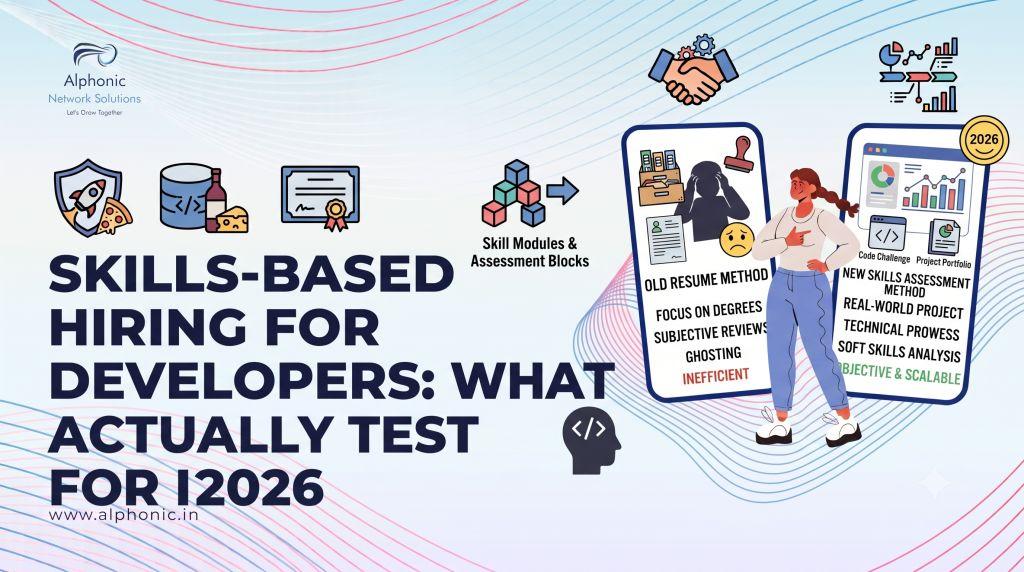
- The Problem With Resume-First Screening
- What to Actually Test For When Skills-Based Hiring Developers
- Building the Skills-Based Hiring Developers Screening Process
- Common Mistakes When Switching to Skills-Based Hiring
- When to Bring in Outside Help
- FAQs
A candidate with a computer science degree from a well-known university and a candidate who taught themselves to code, shipped three real projects, and can walk through their debugging process in detail. If you’re weighing skills-based hiring developers as an approach for your team, here’s the short version: ten years ago, only the degree got past the first filter. In 2026, that’s no longer true, and if your process still works that way, you’re competing for talent with one hand tied behind your back.
According to NACE’s Job Outlook 2026 survey, 70% of employers now use skills-based hiring practices, up from 65% just a year earlier. That’s not a fringe trend anymore. It’s closer to the new baseline, and the companies still screening on degrees and job titles alone are shrinking their own candidate pool for no real benefit.
Why Skills-Based Hiring Developers Is Happening Now
The shift didn’t happen because degrees stopped mattering in some abstract sense. It happened because degree requirements turned out to be a weak predictor of whether someone can actually do the job, and companies that kept using them anyway were quietly filtering out good developers for no good reason.
The data backs this up more directly than most hiring trends do. Research cited across multiple 2026 industry reports puts skills-based assessments at roughly five times more predictive of job performance than education credentials alone. Separately, workforce analytics from Revelio Labs has found that employees hired without a four-year degree tend to stay in similar roles meaningfully longer than degree-holders in the same positions, which matters a lot if retention is part of what you’re optimizing for, not just time-to-hire.
There’s also a practical supply-side reason this matters specifically for developer hiring: some of the strongest engineers working today are self-taught, bootcamp graduates, or came up through open-source contribution rather than a CS program. Screening them out at the resume stage isn’t caution, it’s just a smaller pool to choose from.
The Problem With Resume-First Screening
Resume-first screening optimizes for the wrong signal. A resume tells you what a candidate has been credentialed for or claims to have done. It does not tell you whether they can actually solve the kind of problem your team deals with on a Tuesday afternoon.
A few specific failure modes worth naming:
It rewards resume-writing skill, not engineering skill. Some excellent developers write mediocre resumes. Some mediocre developers write excellent resumes. These are not the same skill, and treating them as a proxy for each other filters out people for the wrong reason.
It can’t catch AI-assisted resume padding. With AI tools making it trivial to generate polished, keyword-optimized resumes, the correlation between “well-written resume” and “capable engineer” has gotten weaker, not stronger, over the last two years.
It filters before you’ve learned anything useful. By the time a resume-first process gets to a technical interview, you’ve already rejected most of your pool based on the least informative part of the entire process.
None of this means resumes are worthless. It means they should confirm what a skills assessment already told you, not replace it. This is the core mechanic of skills-based hiring developers actually respond well to: proof first, credentials second.
What to Actually Test For When Skills-Based Hiring Developers
This is the part most “skills-based hiring” advice skips past with a vague gesture at “test their skills.” Here’s what that should actually mean for a developer role, broken into what matters and how to test it honestly.
Real Problem-Solving, Not Algorithm Trivia
Whiteboard algorithm puzzles test whether someone has memorized common interview questions, which is a different skill from writing good software. A better test: give the candidate a small, realistic problem close to what they’d actually work on, and watch how they approach it, not just whether they arrive at a “correct” answer.
Code Review and Debugging Ability
Handing a candidate a piece of imperfect code and asking them to review it or find the bug tells you more about how they’ll actually perform on your team than a from-scratch coding exercise does. Most of a developer’s real work is reading and modifying existing code, not writing greenfield algorithms.
Judgment Under Ambiguity
Give the candidate a deliberately underspecified problem and see what questions they ask before writing any code. Developers who dive straight into building without clarifying requirements tend to cause the same problem on the job.
Communication About Technical Decisions
Ask the candidate to explain a past technical decision, including one that didn’t work out. How someone talks about a mistake tells you more about their judgment and honesty than almost anything else in an interview.
Working With AI Tools, Honestly Assessed
Since most developers now use AI coding assistants day to day, testing “can you write code with zero tools” is increasingly testing for a skill nobody needs. A more useful test: can the candidate evaluate AI-generated code critically, catch what it got wrong, and explain why.
Culture and Team Fit, Kept Separate From the Skills Test
Fit matters, but it shouldn’t get mixed into the skills evaluation itself. Keep it as its own, clearly labeled conversation so a strong technical candidate doesn’t get downgraded because an interviewer conflated “not like me” with “not qualified.”
Building the Skills-Based Hiring Developers Screening Process
- Define what “good” actually looks like for this specific role before writing a single test question. Skills-based hiring developers well starts here: a backend role and a frontend role need different assessments, and a generic “coding test” tests neither well.
- Replace the resume-first filter with a short, real-world skills task as the first screening step. Keep it short enough that strong candidates don’t drop out from assessment fatigue, thirty to sixty minutes is usually enough to learn something real.
- Score it against a rubric, not a gut feeling. Write down in advance what a strong, adequate, and weak answer looks like, so two different interviewers would score the same submission the same way.
- Move resume and background review to later in the process, once you already know the candidate can do the work. At that point it’s confirming fit, not gatekeeping.
- Keep a human in the loop on judgment calls. Skills-based hiring is not the same as fully automated screening. The assessment narrows the pool; a person still makes the final call.
Common Mistakes When Switching
Treating it as a policy change instead of a process change. Announcing “we’re skills-based now” without actually replacing the resume filter with something real just leaves recruiters defaulting back to old habits, since nobody gave them a new framework for skills-based hiring developers to use instead.
Over-testing. A four-hour take-home assignment doesn’t test skill any better than a focused one-hour task, it mostly tests who has four free hours to spare, which quietly re-introduces the exact kind of bias skills-based hiring is supposed to remove.
Copying a generic assessment off the shelf. A skills test that isn’t actually close to the work the person will do tells you about as little as a resume did.
Forgetting to test AI-tool judgment. A candidate who can’t write a for-loop from memory but writes excellent, well-reviewed AI-assisted code is not automatically a weaker hire in 2026, and a screening process still anchored to memorization-era standards will keep missing that.
When to Bring in Outside Help
Building a genuinely good skills-based process takes real time: writing role-specific assessments, training interviewers to score consistently, and iterating once you see how candidates actually perform against it. For a company hiring one or two developers a year, that overhead rarely pays for itself.
This is where a lot of businesses end up going a different route entirely: working with a development partner who already has a vetted bench of developers, assessed against real project work, rather than building a skills-based hiring developers pipeline internally from scratch. If that’s a better fit than building your own process, our hire developers page breaks down engagement by specialization, and our guide on how to hire a software development company covers the evaluation side of that decision in more depth.
FAQs
What is skills-based hiring for developers?
It’s an approach to evaluating candidates based on demonstrated ability, real coding tasks, code review exercises, and problem-solving under realistic conditions, rather than relying primarily on degrees, job titles, or years of experience listed on a resume.
Does skills-based hiring mean I should drop degree requirements entirely?
Not necessarily. It means the degree shouldn’t be the primary filter. A candidate’s actual demonstrated skill should determine whether they move forward; their educational background can still be part of the picture, just not the gatekeeper.
How long should a developer skills assessment take?
Long enough to learn something real, short enough that strong candidates don’t drop out. Thirty to sixty minutes for an initial assessment is a reasonable target. Assignments running several hours mostly filter for who has free time, not who’s skilled.
Can skills-based hiring work for junior developers who don’t have much to show yet?
Yes, though the assessment should shift toward problem-solving approach and learning ability rather than a portfolio of shipped work, since junior candidates genuinely won’t have as much of that yet.
How do I test whether a developer can use AI coding tools well, not just whether they can code without them?
Give them AI-generated code with a subtle bug or inefficiency and ask them to find and explain it. This tests critical evaluation of AI output, which is a more relevant skill for most 2026 engineering roles than writing everything from a blank file.
Is skills-based hiring more expensive or time-consuming than traditional hiring?
Building the process takes upfront investment, writing good assessments and training interviewers to score consistently. Once built, it usually speeds up later stages, since you’re not running full interview loops for candidates who never had the skill in the first place.
What if I don’t have the internal resources to build a skills-based hiring process?
That’s a legitimate reason to work with a development partner that already vets developers against real project work, rather than trying to build and maintain a hiring pipeline in-house for a small number of annual hires.