Why US Businesses Choose Software Development Outsourcing to India
The Real Concern: Communication and Time Zones
The Real Concern: Quality
What Working With an India-Based Team Actually Looks Like
Why Alphonic
Software Development Outsourcing FAQs
Intro
Software development outsourcing to India isn’t a new idea, but it’s still something US businesses approach with more hesitation than it deserves.
Outsourcing software development to India isn’t a new idea, but it’s still one businesses approach with more hesitation than it deserves. Most hesitation around software development outsourcing to India comes down to two real, specific worries: will communication actually work across the time difference, and will the quality hold up once the contract is signed. Both are fair questions. Here’s a straight answer to both, along with what the cost difference actually looks like and what to check before you commit to a partner.
Why US Businesses Choose Software Development Outsourcing to India
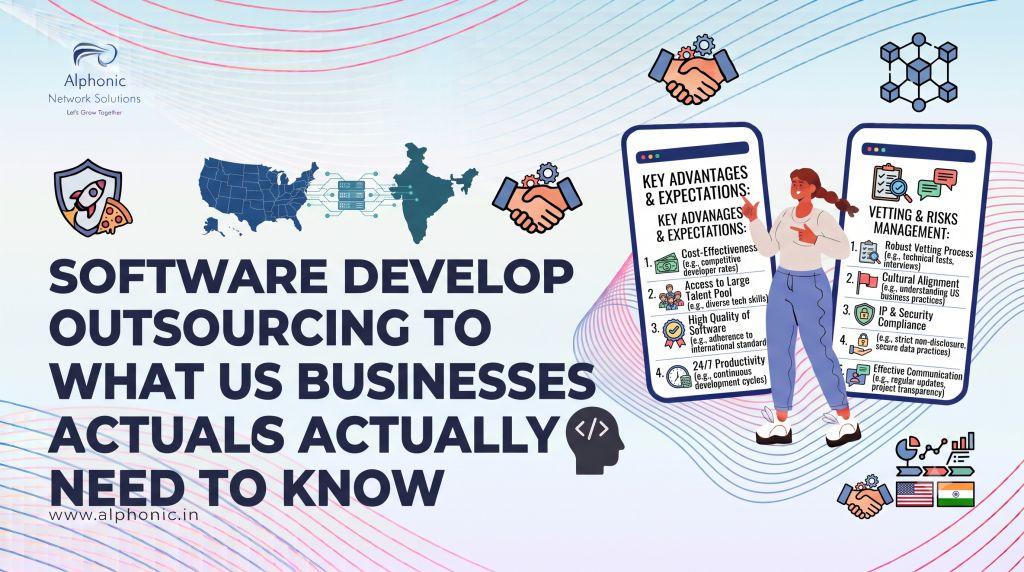
The most obvious reason is cost. Development rates in India typically run 40 to 60 percent lower than US or Western European rates for comparable work. That gap exists because of cost of living differences, not because the work is lower quality, India has one of the largest English-speaking technical talent pools in the world, with strong representation across web, mobile, cloud, and emerging technology work.
The less obvious reason is capacity. A lot of US businesses aren’t outsourcing because they can’t find developers locally, they’re outsourcing because building and maintaining an in-house team for every project is expensive and slow to scale up or down. An outsourced team gives you that flexibility without the long-term overhead.
The Real Concern: Communication and Time Zones
This is the question that actually determines whether outsourcing works, more than cost does. The fix isn’t complicated, but it does need to be handled deliberately rather than assumed.
A working arrangement usually means a few hours of real-time overlap each day for calls and quick decisions, with asynchronous updates covering the rest. Teams that get this wrong usually made the mistake of not agreeing on communication cadence upfront, not because the time difference itself was unworkable. Ask any potential partner exactly how they handle daily updates, who your point of contact is, and how fast you can expect a response outside overlap hours, before you sign anything.
The Real Concern: Quality
The honest answer is that quality varies as much among Indian development firms as it does anywhere else. The way to de-risk this isn’t to avoid outsourcing, it’s to vet properly.
Ask for case studies, not just client logos. Check reviews on Clutch or GoodFirms rather than relying only on testimonials on the company’s own site, those are curated by definition. Ask how they handle code review, testing, and what happens if something goes wrong post-launch. A partner who’s confident in their process will answer these questions specifically. One who deflects to generic reassurance is telling you something too.
What Working With an India-Based Team Actually Looks Like
In practice, most engagements settle into a rhythm within the first few weeks. Daily or near-daily async updates, a standing weekly call during overlap hours, and a shared project tracker so you’re never wondering what’s actually happening. The teams that work well long-term are the ones where communication becomes routine fast, not the ones promising round-the-clock availability that nobody can actually sustain.
Software development outsourcing to India works best when both sides treat it as a real partnership, not a transaction.
Why Alphonic
When people ask why we’re a good fit for software development outsourcing to India, the honest answer starts with fourteen years of doing exactly this.
We’re based in Jaipur, India, with a second office in Dubai, and we’ve been doing software development since 2013. Over 700 projects delivered, a 4.8 rating across client reviews, and recognition from Clutch, GoodFirms, AppFutura, and Developer4u, not because we’re chasing awards, but because that kind of third-party verification is exactly what we’d want to see if we were the ones evaluating a partner.
If you’re evaluating outsourcing for the first time, or you’ve been burned by a partner who overpromised before, the first conversation is usually the best way to find out if this is a fit, not a sales pitch, just a straightforward look at what you need and whether we’re the right team for it.
Check reviews on Clutch or GoodFirms rather than relying only on testimonials on a company’s own site.
Software Development Outsourcing FAQs
Here are the questions we hear most often from businesses considering software development outsourcing to India.
How much cheaper is outsourcing to India, really?
Typically 40 to 60 percent lower than US or Western European rates for comparable work. The exact number depends on the complexity of the project and the seniority level you need, but that range holds up across most standard development work.
How does communication work across the time difference?
Most working arrangements build in a few hours of real-time overlap each day for calls and urgent decisions, with async updates covering the rest. It takes deliberate setup in the first few weeks, but it’s not the obstacle people expect it to be once a routine is established.
How do I know if a development partner’s quality is actually good?
Ask for real case studies, not just a client logo wall. Check reviews on Clutch or GoodFirms rather than relying only on testimonials on their own site. Ask specifically how they handle code review and what happens if something breaks after launch, and see how confidently they answer.
What size projects make sense to outsource?
Both small, well-defined projects and large, ongoing engagements work, they just need different structures. A single feature or MVP can often be scoped and delivered in a few months. Larger, ongoing product work benefits from a dedicated team model rather than a one-off project engagement.
Do I lose control over the project by outsourcing?
Not if the process is set up right. You should have visibility into progress through regular updates and a shared project tracker, and a real say in decisions, not just a status report after the fact. If a partner can’t offer that level of visibility, that’s worth treating as a red flag before you sign anything.