Table of Contents
Why “Predictions” Posts Age Badly
Already Mainstream, Not a Trend Anymore
Genuinely Changing Right Now in Web Development Trends
Worth Watching, Not Worth Building Around Yet
How This Affects What You Should Actually Build
Where Alphonic Fits
FAQs
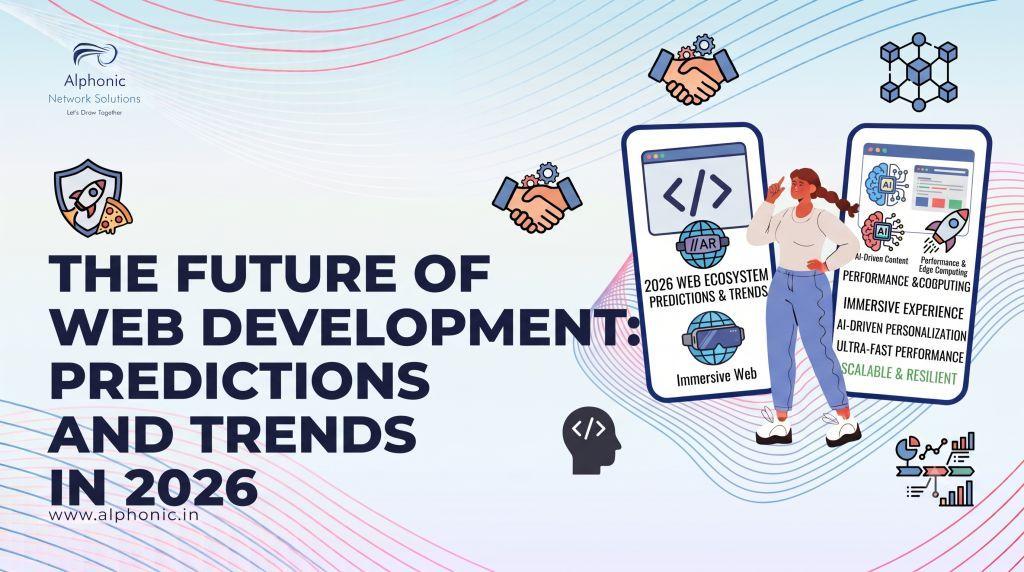
Most “web development trends” content follows the same formula: a list of seven or eight buzzwords, a sentence on each, and a vague claim that all of them are about to change everything. A few years later, half the list turned out to be already-standard practice and the other half never really went anywhere. This post skips that formula. Instead of predicting, it sorts web development trends into three honest categories: what’s already normal, what’s genuinely shifting right now, and what’s interesting but not worth building a strategy around yet.
Why “Predictions” Posts Age Badly
Progressive Web Apps and basic AI-powered chatbots were “the future” a few years ago. Now they’re just table stakes, most serious web platforms have some version of both, and nobody calls it forward-thinking anymore. That’s the core problem with year-stamped predictions content: the interesting trends of a few years back are today’s baseline expectations, and articles that don’t get updated end up presenting old news as fresh insight.
This is worth knowing if you’re evaluating a development partner too. If a company’s pitch is built entirely around technology that’s been standard for several years, that’s not a red flag about the technology, it’s a signal the pitch itself hasn’t been updated in a while.
For more info: WhatsApp us at +91 9887133338
Already Mainstream, Not a Trend Anymore
These used to be differentiators in web development trends coverage. Now they’re just what a competent build includes by default.
Progressive Web Apps. Offline functionality, app-like experience in a browser, installability without an app store, this is a standard consideration for most consumer-facing web products now, not a bonus feature.
Responsive, mobile-first design. This stopped being a “trend” the better part of a decade ago. It’s simply how sites get built.
Basic AI-assisted features. Chatbots, simple personalization, and recommendation widgets are common enough that they no longer signal innovation on their own. What matters now is how well they’re implemented, not whether they exist.
Cloud-based infrastructure. Deploying on cloud infrastructure rather than a single physical server is the default assumption for any serious web project, not a forward-looking choice.
Genuinely Changing Right Now in Web Development Trends
This is where the real movement is, the stuff actually worth paying attention to if you’re planning a build in the next year.
AI-Assisted and Agentic Development
The bigger shift isn’t AI writing autocomplete suggestions anymore, it’s AI agents handling larger, more autonomous chunks of the development workflow: scaffolding features, writing test suites, and even reviewing code changes with real context about the rest of the codebase. For a business commissioning a web project, this shows up as faster builds without necessarily faster teams, which is worth asking a development partner about directly rather than assuming it applies.
WebAssembly Maturing Into Practical Use
WebAssembly lets developers run code written in languages like C++ or Rust directly in the browser at near-native speed. It’s moved past the experimental stage into genuine practical use for performance-heavy web applications, image editing, gaming, and data-heavy dashboards being the clearest examples.
Edge Computing for Web Delivery
Serving content and running logic from servers physically closer to the user, rather than one central location, meaningfully cuts load times for global audiences. This has gone from a niche optimization to something worth planning for in the initial architecture of any site with a genuinely international user base.
Accessibility as a Build Requirement, Not an Afterthought
Legal requirements and simply better standards have pushed accessibility from a nice-to-have into something increasingly built in from the start rather than patched on later. Retrofitting accessibility into an existing site is measurably more expensive than designing for it from the beginning.
Privacy-First Architecture
Stricter data protection expectations and regulations mean privacy considerations, what data gets collected, how it’s stored, how consent is handled, are increasingly a day-one architecture decision rather than a compliance checkbox added before launch.
Worth Watching, Not Worth Building Around Yet
A few things that get mentioned constantly in trend content but genuinely aren’t mainstream requirements yet for most businesses:
Fully decentralized, blockchain-based web architecture. Interesting for specific use cases (supply chain transparency, certain fintech applications), but not something most web projects need to plan around.
Voice-first interfaces. Voice search optimization matters for content discoverability, but full voice-driven web interfaces remain a narrow use case outside specific accessibility and smart-home contexts.
No-code and low-code platforms replacing custom development. These are genuinely useful for simple, standardized needs. They are not a replacement for custom development on anything with real complexity or specific business logic, despite how often that claim gets made.
How This Affects What You Should Actually Build
The practical takeaway for anyone tracking web development trends isn’t “adopt everything on this list.” It’s this: don’t pay a premium for technology that’s already standard, and don’t skip planning for the things that are genuinely shifting the ground under web development right now.
A few concrete questions worth asking before starting a new web project:
- Does the site need to perform well for a genuinely global audience? If so, edge delivery is worth planning for from the start, not adding later.
- Is accessibility a real requirement (which, for most commercial sites, it functionally is)? Build it in from day one.
- Will the site have performance-heavy interactive features? That’s where WebAssembly becomes relevant, not for a standard content site.
- Is the development team actually using current AI-assisted workflows, or claiming AI capability without showing what that means in practice?
If you’re weighing which technology stack fits your specific project, our pages on Node.js, Laravel, and React.js go deeper on where each one fits.
Where Alphonic Fits
We build web projects around actual web development trends worth acting on, not around whichever technology is generating the most buzz that quarter. That means being direct about what’s genuinely worth investing in for a given project and what’s a distraction, even when the distraction has better marketing behind it.
Our web development services page covers how we approach a build from architecture through launch, and if you’re still deciding whether to build in-house or bring in outside help, our guide on how to hire a software development company covers that evaluation in more depth.
For more info: WhatsApp us at +91 9887133338
FAQs
What are the most important web development trends right now?
AI-assisted development workflows, WebAssembly for performance-heavy applications, edge computing for global performance, and accessibility built in from the start are the ones with genuine, current momentum, rather than the recycled “PWAs and chatbots” list that shows up in most trend content.
Is Progressive Web App development still worth investing in?
Yes, but it’s not cutting-edge anymore, it’s closer to a baseline expectation for most consumer-facing web products. The question isn’t whether to build a PWA, it’s whether your specific project needs the offline and installability features it provides.
Should every website use edge computing?
No. It matters most for sites with a genuinely global, geographically spread-out user base where load time differences across regions are significant. A site serving a single country or region gets little practical benefit from it.
How is AI actually changing web development in practice, beyond chatbots?
The more significant shift is AI handling larger portions of the development workflow itself, scaffolding code, generating test coverage, and assisting with code review, rather than just powering user-facing features like chat widgets.
Is WebAssembly relevant for a typical business website?
Usually not. It matters for performance-intensive applications like in-browser image or video editing, gaming, or heavy data visualization. A standard content or e-commerce site won’t see much benefit from it.
Do I need to worry about web accessibility compliance?
For most commercial websites, yes, both from a legal-risk perspective in many jurisdictions and because it genuinely expands who can use your site. Building it in from the start costs meaningfully less than retrofitting it later.
How do I know if a development company is actually current on web development trends, versus just claiming to be?
Ask specifically what’s changed in their process over the last year or two, not just what technologies they list. A team that can explain a real, concrete shift in how they work is a better signal than a features list that reads the same as it did three years ago.